How Mojo removed credits from its paywall and grew subscription revenue 14%
When more choices on the paywall didn't help users decide, they kept users from subscribing.

Why Mojo added credits to the paywall
When Mojo Pro AI launched, the team wanted to give users flexibility. Not everyone needs unlimited access to AI-powered templates and effects. Some users just want to try a few premium features before committing.
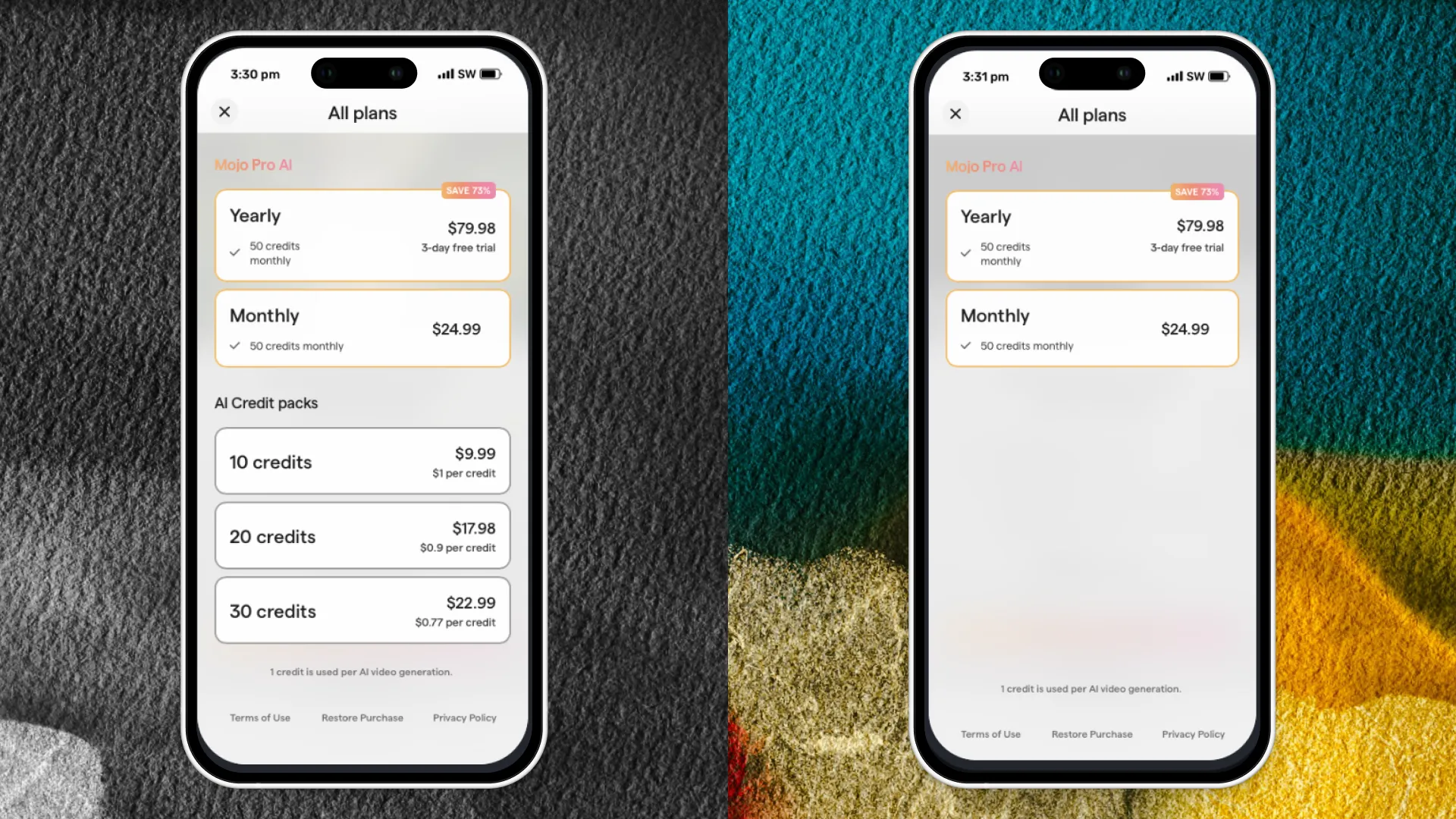
So the team built a credit system sitting on the same paywall as Mojo's subscription plans. Users could pick whichever fit their usage pattern: a subscription for heavy use, credits for lighter or occasional use.
The logic made sense: broader accessibility, lower barrier to entry, more monetization options.
How choice overload and cannibalization hurt subscription revenue
After launch, two issues surfaced.
- Cognitive load went up. Showing credits alongside subscriptions turned one decision (“Is the subscription worth it?”) into a comparison problem (“Subscription or credits? Which is better value? How do credits even work?”). The result was more drop-offs and slower decision-making, a textbook paradox of choice.
- Higher-value users were escaping to credits. This was the bigger problem. Users who would have subscribed were buying small credit packs instead: lower commitment, lower LTV, lower retention. The credit option wasn't generating incremental revenue. It was pulling users away from the subscription.
The test: hiding credits with Superwall
The team ran a straightforward A/B test in Superwall:
- Control (A): Existing paywall with subscriptions and credit packs.
- Test (B): Same paywall with subscriptions only, credits hidden.
No pricing changes, no copy changes, no redesign. One variable: whether credits appeared on the paywall. Credits stayed available for existing Mojo Pro AI subscribers to top up their balance; the team only removed them from the initial purchase decision.
Results: +14% new subscription revenue
- New subscription revenue increased +14%, driven by more users choosing subscriptions and higher ARPPU
- No significant increase in drop-off from the paywall
- No meaningful increase in internal AI costs
- Results were clear within one week
The credit option wasn't adding value as an alternative path. It was an escape hatch that pulled users away from the higher-LTV decision.
— Michal Parizek, Growth Manager, Superwall
Takeaways for subscription apps
- Test your monetization mix. If your paywall shows multiple purchase types, test whether they're complementary or cannibalistic. The Mojo team assumed both options maximized revenue. The data said otherwise.
- Simpler paywalls can convert better. A lower-commitment option next to a subscription anchors users on the cheaper price. One clear path often outperforms a flexible one.
- The right choice at the right time. Credits weren't wrong as a product. They were wrong as a first impression on the paywall. Keeping them for existing subscribers while removing them from the initial purchase decision was the move.
Removing credit packs from the paywall was one experiment that took an afternoon to set up, and it changed how Michal and the Mojo team think about paywall complexity.
This case study is based on insights from Michal Parizek, Growth Manager at Superwall. Michal spent three years running paywall and pricing experiments at Mojo, driving a 60% ARPU increase, before joining Superwall.
 Sebastian Szturo
  Cal AI
  Ahead App